Robot Motors Robot Books

Kits and Toys
 Robot Kits
 Robot Kits II
 BattleKits
 Robot Toys
 Solar Kits
 Robot Arms
 Robosapien
 Basic Stamp Kits
 Lego MindStorms

Books
 Beginners Books
 Hobby Robots
 Robot Sports
 Electronics
 Mechanics
 Robot Minds
 Books for Kids
 Robots at Work
 Advanced Books
 Used Books

More Robotics
 Real Robots
 Robot Motors
 Motor Controller
 Robot Parts
 Magazines
 Robot Videos
 Robot News
 Newsletter
 RoboLinks
 Service

Magmotors have been specifically designed and battle-hardened for use in robot combat competition. They have also been used in applications like motorized scooters, go karts, electric bicycles, and small electric motorcycles with excellent results. Take a look at the specifications of the Magmotors. We think that you will agree that these are the ultimate motors for combat robots.

Sign up for our Robotics Newsletter!
Enter your Email:


robot
   Magmotor
robot


We offer three different motors for combat robots:

C40-300 S28-400 S28-150
3.8 Horsepower 4.5 Horsepower 3 Horsepower
4" Diameter 3" Diameter 3" Diameter
6.9" Long 6.7" Long 4" Long
3840 oz-in Torque 3720 oz-in Torque 1970 oz-in Torque
84% Efficiency 83% Efficiency 82% Efficiency
24 Volts 24 Volts 24 Volts
4000 RPM 4900 RPM 6000 RPM
11.9 Pounds 6.9 Pounds 3.8 Pounds
Built-in Capacitors Built-in Capacitors Built-in Capacitors
Ferrite Magnets Neodymium Magnets Neodymium Magnets


Magmotor - Robot MotorThe quest for the perfect motor is one that all robot competitors have gone through. There are several choices available but as many people have found, only a few of them will work well in battle.

What makes a good motor?
There are several things you should consider when choosing a motor. The most obvious are power, weight, and efficiency, but there are several other factors that are just as important.

  • Does the motor have a usable RPM range?

  • Will it put controller-destroying voltage spikes on your electrical system?

  • Is the thing solidly built, or will it fall apart in the middle of a battle?

  • Can it withstand the heat build-up of high-Amperage operation?

  • Will the motor use the limited power you have on-board efficiently, or will it drain your batteries before the match is over?

  • Does it produce radio noise and interfere with your radio control?

  • Is the motor and shaft designed for easy mounting?

Let's look at each of these questions in detail and see how the Magmotors handle them.

Horsepower and Torque
Raw horsepower is very important in combat. If you watch the battles carefully, you will see that the robot with the most pushing power is often the one that wins. The horsepower and torque of these motors are higher than other reversible, permanent magnet motors in this size range. Some gearmotors can't even achieve 3840 oz-in, and that is after multiplying the torque with a gearbox. Remember our torque figure is taken directly from the motor shaft before any gear reduction. (Please note that this is the theoretical peak torque when stalled. Operating any high-performance motor while stalled will damage it). Other popular motors put out 1 to 2 horsepower each. With two Magmotors you will have up to 9 horsepower at your command!

RPM Range
Usually, the higher the voltage and RPM of a motor, the higher its efficiency will be. Some motors have high efficiency, but at a no-load speed of 20,000 RPM or more. Gearing such high RPM down to a usable wheel speed takes several stages of gear reduction. This is heavy and wastes power and the efficiency advantage usually disappears. The tricky part is making a moderate speed motor that is also highly efficient. The relatively low RPM of our motors makes the speed reduction much easier. Most people use one or two stages of roller chain and sprockets to achieve the speed reduction. Gearboxes for the S28s are available from Team Whyachi.

The C40 Magmotor being tested on a dynamometer
Dyno Test

Solid Construction - Easy Mounting
The Magmotors are made from two sturdy aluminum castings and a seamless body. Some motors use a rolled can with the magnets glued in place. Motors with rolled construction have been known to rip open under severe full-throttle direction changes. That can't happen with our seamless design. The output shafts are 1.75 inches long and 5/8" diameter for the C40 and 1/2" diameter for the S28s. The long shaft length and a 3/16" keyway (1/8" for the S28s), make it easy to mount pulleys, sprockets, and gears in just the position you need them. A second 1/2" diameter shaft extends 3/4" from the rear of the motors. This is very handy for mounting encoders, fans, tachometers, brakes, or any other devices you might need. If you don't need the rear shaft, you can cut it off flush with the face of the motor.

Some motors use an internal fan to keep them from overheating. The Magmotors are efficient enough to operate without a fan. This has three advantages: (1) The motor housing is completely sealed so nothing can enter the motor and damage it; (2) The sealed motor tends to contain interference-causing radio frequency noise that would otherwise escape through the ventilation holes; (3) The power that would normally be used to run the fan can go directly to driving your robot.

The armature rides in two large high-quality ball bearings and it is dynamically balanced using epoxy rather than by the normal method of drilling the laminations. Drilling can cause eddy currents in the laminations, which increase motor heating.

Each of the four brushes has its own heavy-duty motor lead made from mil-spec 10-gauge flexible stranded wire, (12-gauge for the S28s). Each copper strand is coated with pure silver to protect against oxidation and to get the lowest possible resistance in crimped connections. These leads are flexible but not "floppy", so they tend to stay where you put them. The four leads have high-temperature Teflon insulation rated for 200° C, (392° F), so they can handle high current without melting.

Detailed drawings are available here: C40 drawing, S28 drawing.

Efficiency
Getting high efficiency from a low-Voltage motor is not easy. There are many factors that will have an effect on efficiency. We have tweaked each of these factors to achieve the amazing efficiency of the Magmotors.

  C40-300 S28-400 S28-150
Peak Efficiency (PE) 83.7% 83% 81.9%
RPM at PE 3700 RPM 4500 RPM 5500 RPM
Horsepower at PE 1.1 HP 1.4 HP 1.0 HP
Current at PE 41 Amps 51 Amps 37 Amps
Range of 80%+ Eff. .6 to 2.0 HP .7 to 2.3 HP .6 to 1.4 HP
Range of 75%+ Eff. .4 to 2.6 HP .5 to 3.1 HP .4 to 2 HP

As you can see from the above chart, the efficiency of the motors is very high over a broad range of power. Please note that all our performance numbers are from motors that have neutral timing. Most motor manufacturers quote efficiency numbers from motors that have advanced timing. Advanced timing is a bad idea when you need to run the motor in both directions. Our motors are shipped with neutral timing for good operation in both directions. If you use the motor in one direction only, you can advance the timing and get even more RPM and power. (But do not run the motor backwards if the timing is advanced). Timing adjustment is easy with the Magmotors.

The armatures are wound with very heavy gauge wire, and all the space in the armature is used. We left no power-robbing "empty air" in the slots; they are packed with copper! The S28s have skewed armature laminations to eliminate the heavy "cogging" that results from using the extremely powerful neodymium magnets. The C40 motor uses straight laminations, but the cogging is kept to a very low level by using a 42-bar commutator. The huge 1.75" diameter of the commutator combined with the four massive brushes and the 42 bars enabled us to get high power and high efficiency from this smooth-running motor, (the S28s have 21 bars). As far as we know, the Magmotors have the highest efficiency of any 24-volt reversible permanent magnet DC brush motors in their size ranges.

Motor Armature with 42-Bar CommutatorAnother benefit of the four-brush, 42 and 21-bar designs is the absence of excessive electrical noise. While all motors produce some electrical noise, cheaper motors with fewer commutator bars are more likely to send noisy voltage spikes back to your controller. This can destroy your expensive electronics. With more bars, each time a brush comes into contact with a new bar, the timing of the winding connected to that bar is closer to being optimal. In low-quality motors with fewer bars, each winding will pass through a wider range of angular offset from the magnets. This causes the brush to spark more and generates more electrical noise and voltage spikes.

Built-in Capacitors
BattleBots veterans know how important it is to reduce the radio frequency noise. Without capacitors most motors will produce enough RF noise to shorten the range of your radio control. This RF noise can sometimes make it impossible to control your robot. The Magmotors come with four capacitors built right in to the motors. Each of the four brushes has a capacitor wired to its nearest neighbor on each side. There is no connection to the motor housing. Shunting your RF noise to the housing, (and ultimately to your robot's frame), has unpredictable results and we don't recommend it. Mounting the caps inside the motor works better than mounting them on the outside but it can be difficult to do. We do the work for you so your motor is ready to run as soon as you get it!

Save Weight
Efficiency is important for several reasons. A high-performance motor will convert most of the power it draws into torque and horsepower, while an ordinary low-efficiency motor will turn much of your battery power into heat. The weight limits are strict in robot competitions and it is important to make the best use of every pound of battery you have on board. Two 12 volt, 16 Amp-hour lead-acid batteries should have enough capacity to power your dual Magmotor-equipped robot to victory in a three-minute match. Some other motors require 36, 48, or even more Volts to get sufficient power. More Voltage means more batteries and more weight. 24 Volts is all you need with the Magmotors.

Motors that are used in the heavy and super-heavyweight classes range from about 8 to about 26 pounds. Motors for the light and middleweight classes range from about 2 to about 8 pounds. The C40 weighs in at 11.9 pounds. The S28-400 tips the scale at 6.9 pounds, and the S28-150 is just 3.8 pounds.

     S28-150 - Just 3.8 Pounds!
Magmotor S28-150Using Your Magmotor
The high current these motors are capable of drawing requires the use of high quality controllers. The terminal resistance of the C40 is .050 Ohms. The S28-400 has a terminal resistance of .042 Ohms, and the S28-150 has a terminal resistance of .064 Ohms. That gives theoretical maximum current draws of 375 Amps (S28-150), 480 Amps (C40), and 570 Amps (S28-400). But in practice, you will never see this level of current. In order to draw that much current you would have to use a battery that stays at 24 volts while supplying high current; you would have to have no resistance between the motor and the battery; the motor would have to be totally stalled; and it would have to be at room temperature (the resistance of all motors increases when hot).

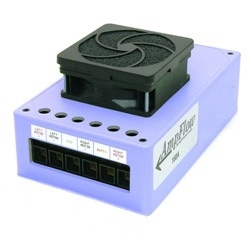
Even the best 12-volt batteries in the 16 Amp-hour size range have an internal resistance of at least .007 Ohms each. Your controller will have at least .002 Ohms. The motors have between .042 and .064 Ohms. Add to that another .004 Ohms for your connectors, switches, and wiring, and you will have a circuit with between .062 and .084 Ohms. This gives theoretical maximum current draws of 285 Amps (S28-150), 340 Amps (C40), and 390 Amps (S28-400). The actual figures will be even lower if you have any other load on the battery (due to battery voltage droop). This puts the current draw within the range that some commercial speed controllers can handle. We suggest that you use our AmpFlow motor controller.

The C40 and S28-400 have tested fine with momentary current draws of over 500 amps but if you are using any high-performance motors in your weapon and your weapon becomes stalled, you must back off on the throttle to prevent damage to the motors.

By the way, one of the "rules of thumb" for determining if a motor is high in quality and efficiency is the difference between the no-load current, and the maximum current. A good motor might be able to draw 50 times its no-load current when stalled. Some very inefficient motors can do no better than 10 times or so. With a no-load currents of 3.5 Amps (4.5 Amps for the S28-400), the Magmotors can draw an amazing 110 to 137 times their no-load currents!

Here are some tips for break-in, repair, timing adjustments, and technical specifications.

The S28-400 Magmotor
S28 Magmotor

Overvolting
It has long been the tradition in robot combat to use double the motor manufacturer's recommended maximum voltage. At 24 Volts the C40 Magmotor is already very powerful. At 36 Volts it will develop 8.6 horsepower, but you run the very real risk of damaging your motor. If you decide to take the risk, we can offer the following suggestions: Limit the maximum current to no more than 350 Amps (lower for the S28s); Use the highest possible gear reduction; Use the motor in one direction only, do not try to reverse it; And time the brushes for optimal operation in that direction. The S28-400 puts out a respectable 1.1+ horsepower at 12 Volts and over 2.5 horsepower at 18 volts. If you are using this motor in a light or middleweight and you are bumping up against the weight limit, you might want to consider eliminating some battery weight and running the S28s at a lower voltage. More tips on overvolting.

Choosing your motor
Which motor is best for your application? The S28s have incredible power to weight ratios and for most weight-sensitive applications these would be the best choice. The C40 weighs more than the S28s, but in some cases this is advantageous. The higher motor mass will decrease the rate of motor heating for a given level of power. If you need high power for several minutes (as in a continuously spinning weapon), the larger C40 might be a better choice. The following chart gives some general guidelines for selecting the best motor.

Notice that the S28-150 is not recommended for a heavy spinner. If you have 15 or more pounds in a continuously spinning weapon, you are much better off with the larger S28-400 - even if you have to knock the extra three pounds off of your weapon to make it under the weight limit. The same is true for Middleweight drive motors. Remember, under high loads these motors will draw as much current as several arc welders combined. The larger the motor, the longer it will take for the heating to reach temperatures that are potentially damaging. When in doubt, choose the larger motor. It adds just three pounds and costs almost the same as the smaller motor - plus it has 50% more power!

  C40-300 S28-400 S28-150
Lightweight Drive N/A Good Best
Middleweight Drive Good Best Good
Heavyweight Drive Good Best N/A
Super H.W. Drive Best Best N/A
Massive Spinner Best Good N/A
Light Spinner Good Best Good
Heavy NCW* Good Best Good
Light NCW* N/A Best Best

*NCW = Non continuous weapon (hammer, lifter etc.)

Warrantee
These motors are custom manufactured for us by Magmotor. Their product lines include high performance brush and brushless DC servomotors for factory automation, semiconductor equipment, medical and office products, and automotive applications. We worked with their engineers to develop motors that are ideal for robot combat. The motors are warranted to be free from manufacturing defects, and fully operational when you receive them. The object of the BattleBots competition is to destroy or immobilize your opponent. Obviously we can not offer a refund policy for motors that have been used in these conditions. If you do damage your motors, replacement parts are available for all components.

Customer Service
RobotBooks.com is the exclusive distributor of these motors. Please note that our custom motors are not the same as the standard motors from the Magmotor Company. These motors are not available directly from Magmotor. Modifications include: High-current brushes and shunts, brush holders and insulators, high-temperature springs, custom windings, capacitors, rear end bell, shaft, and oversize commutator. About the only things the custom and standard motors have in common are the armature laminations and the front mounting plate. We do all the customer support for our custom motors. Please send all questions, billing, shipping, and customer service inquiries directly to us at . (All inquiries to sent to the Magmotor company will be forwarded back to us), or phone us at 650 593-6906. Please read these important safety instructions.

Price and Shipping
Using rare earth magnets is normally the only way to get high efficiency from a low-Voltage motor. While these magnets are very strong, they are also extremely expensive. The cost of rare earth magnets in a motor the size of the C40 would have been astronomical. We studied the alternatives and decided to go with a high-energy-product ferrite magnet known as "T9". The T9 magnet material along with the other design features listed above have enabled us to achieve the same high efficiency of rare-earth in a much less expensive motor. Our cost cutting has enabled us to price the C40 at $299. The S28-400 is smaller than the C40 so we can use neodymium rare earth magnets in that motor and still keep the price reasonable at $349. The S28-150 uses less neodymium than the S28-400 so we are able to price it at $299. If you calculate the cost per horsepower, and the horsepower per pound of other available motors, you will see what great values these are.

Shipments must be to a street address; we can not ship to a PO Box. We offer Free Shipping (standard domestic), on single orders of 8 or more motors. Please allow 7-10 days for orders shipped by UPS ground, 3-4 days for orders shipped by 2nd day air, and up to 14 days for international orders.


  We accept Visa, MasterCard, and PayPal.

C40-300 Magmotor $319
S28-150 Magmotor $299
S28-400 Magmotor $359

Replacement parts are available here


"That's a beautiful motor! Wow. Good work. Great price. This should become standard equipment for all large robots."
          --Edwin Wise.   Mad Scientist and author of Applied Robotics

"Very powerful. Too fast on 24 volts even with poor batteries."
          --Mike Schreiber.  Builder of the Electri-Flyer electric bicycle.

"As the BattleBot competitions continue to grow, participants are constantly trying to make their robots quicker, stronger and faster. With nearly four horsepower and 3840 oz-in torque, the 11.9-pound C40 Magmotor is ideally designed for our participants. Since power is often the deciding factor in BattleBot competitions, more and more participants are selecting Magmotor to power their robots with a lightweight, high-efficiency motor that provides plenty of power on demand."
          --
Trey Roski.   CEO of BattleBots.

"As the first motor designed specifically for robotic combat, the Magmotor performs fabulously! It combines incredible power and some of the best features you could ask for when looking for a high-end motor for a BattleBot. It is the most powerful and finest constructed DC permanent magnet motor that I've ever used. I chose Magmotor for the weapon motor in Nightmare and I am definitely a very satisfied customer!"
          --Jim Smentowski.    BattleBots Champion (Nightmare, Backlash)

"The Magmotor packs a lot of power into a light-weight package. They give Minion the power it needs and I still have weight to spare!"
          --Christian Carlberg.    BattleBots Champion (Team Cool Robots)

"Get the best motors you can afford. Good motors are the foundation upon which all else rests. People can win with hokey electronics or even with inoperative weapons, but good motors make good robots."
          --William Gurstelle.    Author of Building Bots : Designing and Building Warrior Robots

"We were extremely pleased with the performance of the 4" Magmotor in our middleweight Heavy Metal Noise at BB 4.0. The motor supplied an insane amount of energy to our kinetic disk weapons. Time to spinup was minimal and after combat the motor was never more than mildly warm to the touch."
          --Jay Johnson.    BattleBots Competitor (Big Bang Robotics)

"I've been building robots as a hobby for about 30 years and this is definitely one of the best motors (power, weight, cost, quality), that I've ever encountered. Since I've never built a 'BattleBot' before, I decided to focus most of my attention on other aspects of the design and having this motor meant that I didn't have to spend many hours 'tweaking' an inferior motor just be competitive."
          --Billy Moon.    BattleBots Competitor

"I can attest to their super high quality of craftsmanship and design. We tested them with a few different controllers and monitored the results using a Tektronix digital scope and a digital ammeter. Results: This is the largest motor we have tested and amazingly it had the cleanest feedback signal of any motor yet. Generally the higher the quality of motor mechanics, windings, brush and commutator, the cleaner this signal is. This means these motors are less likely to blow a speed controller due to transient voltage spikes.
          These motors are VERY well built. We saw no appreciable heat up in the testing we did. We did a lot of stall and near stall testing. These are amazing motors and are ridiculously powerful."
          --
Alexander Rose.    4/2001.   BattleBots Champion (Toro, T-minus, Matador)

 
Sign up for our Robotics Newsletter! Enter your Email:

Advertise your product on RobotBooks.com

Beginners Books  |  Hobby Robots  |  Robot Sports  |  Electronics  |  Mechanics  |  Robot Minds  |  Robot Fiction  |  Books for Kids
Robots at Work  |  Mars Robotics  |  Advanced Books  |  Recommended Books  |  Robot Kits  |  Robot Kits II  |  Solar Kits  |  Robot Arms
Robosapien  |  Basic Stamp  |  BioHazard  |  Robot Toys  |  Muscle Wires  |  Lego Mindstorms  |  Real Robots  |  Robot Motors  |  Motor Controller
Used Books  |  Robot Parts  |  Magazines  |  Robix  |  Robot Videos  |  Robot News  |  Newsletter  |  RoboLinks  |  Customer Service